Széchenyi & Gellért Thermal Baths

The Spa Capital of Europe & Artesian Wells
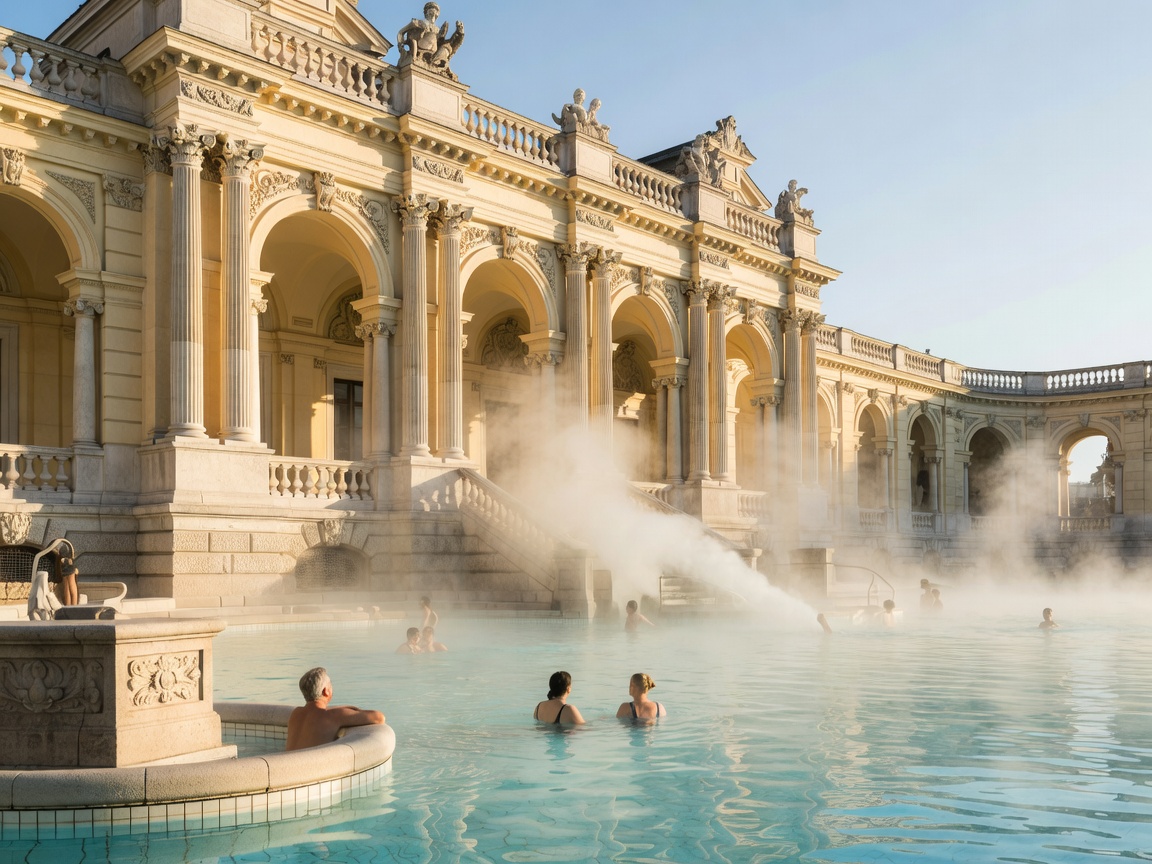
Budapest rests upon an unprecedented geological fault line separating the Buda Hills from the Great Hungarian Plain. Over 120 thermal springs deliver more than 70 million liters of mineral water every single day. Foremost among its institutions are Széchenyi Gyógyfürdő—one of Europe's largest medical bath complexes—and the Art Nouveau masterwork of Gellért Thermal Bath.
Széchenyi's primary source is supplied by the Saint Stephen well, drilled in 1938 to a depth of 1,246 meters. The mineral water emerges at a scalding 77°C (171°F) before being cooled into twenty-one indoor and outdoor pools ranging from 28°C to 38°C.
Budapest Bath Etiquette
Unlike Japanese onsens or Finnish saunas, modest swimwear is strictly required across all communal indoor and outdoor pools at Széchenyi and Gellért. Flip-flops and swimming caps (for the dedicated swimming lap pools) are mandatory.
Architectural Palaces of Healing
Each landmark represents a distinct architectural pinnacle:
- Széchenyi (Neo-Baroque): Completed in 1913, featuring massive canary-yellow courtyards where locals famously play floating chess matches amidst drifting steam.
- Gellért (Secession / Art Nouveau): Opened in 1918, adorned with turquoise Zsolnay ceramic tiles, stained glass skylights by Miksa Róth, and classical marble colonnades.
Balneological Indications
The waters contain calcium, magnesium, hydro-carbonate, sodium, sulfate, and fluoride ions. Hungarian physicians routinely prescribe medical passes to both baths for chronic joint inflammation, degenerative spinal conditions, and post-traumatic orthopedic rehabilitation.
Independent Visitor Observations
“Floating in Széchenyi's outdoor pool while snowflakes dissolve in the steaming 38-degree water, surrounded by neo-baroque statues, is a grand cultural ritual like no other in Europe.”
“Gellért is an aesthetic revelation. The natural acoustics under the vaulted glass dome lend swimming an almost cathedral-like solemnity.”